Control SystemsSystem IdentificationNI-DAQLabVIEWMATLAB
Brief
Identify a real DC motor, then close the loop on its speed.
Rather than simulate an idealized motor, this project is grounded entirely in
hardware measurements: identify the motor from a real step test, build a model from
the data, then design and validate a speed controller on the same rig — and report only
numbers that came off the bench.
System Identification
A 0.1 V step gives a clean first-order plant.
A 0.1 V step drives the motor while the tacho-generator output is logged through
NI-DAQ at 100 samples/s. The response is first-order, so the plant reduces to a
single gain and time constant.
Quantity
Value
DC gain, K
36.52 (tacho-V / input-V)
Time constant, τ
0.070 s
Open-loop pole
−14.3 rad/s
Identified model
G(s) = 36.52 / (0.070 s + 1)
Closed-Loop Control
Proportional feedback makes the motor ~3.5× faster.
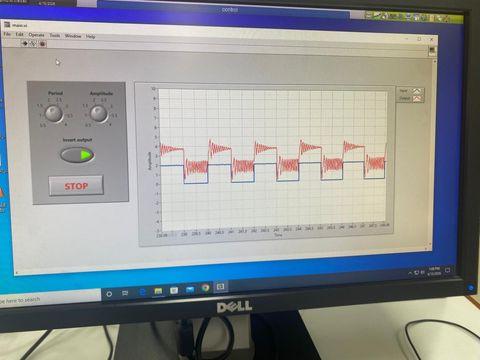
Driving the closed loop with a 1.979 V square-wave reference (2 s period), the
controlled motor tracks each step. Feedback collapses the time constant and tightens
the response:
Metric
Open loop
Closed loop
Time constant
0.070 s
0.020 s
Rise time (10–90%)
—
0.030 s
Speed regulation
—
20–28% under load
Closed-loop rig tracking a square-wave speed reference in LabVIEW — output follows each commanded step.
Analysis & Write-up
Theory applied to measured parameters, reported IEEE-style.
The Final Value Theorem predicts the steady-state output and the Routh-Hurwitz
criterion confirms closed-loop stability — both applied to the identified parameters
rather than textbook values. The full study is documented as an IEEE-format paper, with
every figure traceable to a hardware experiment.