A half-car model captures what a quarter-car can’t: not just bounce (the body
heaving up and down) but pitch (the body rocking front-to-back), plus the
independent hop of the front and rear wheels. The goal was to model that behaviour and
evaluate the ride a driver actually experiences over a road disturbance.
The Model
Equations of motion, cast into state space.
The sprung body and the front/rear unsprung masses, coupled by suspension
springs/dampers and tyre stiffness, give a set of coupled second-order equations of
motion. These are assembled into a state-space representation so the whole system
can be simulated and analysed with standard linear tools.
Simulation
A single bump, and the ride that follows.
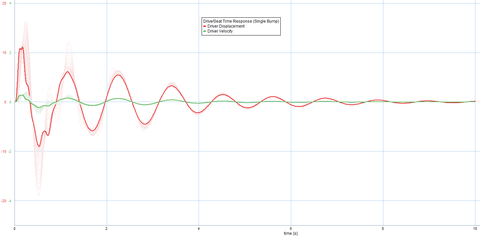
Driving the model with a single road bump and watching the driver/seat displacement
and velocity shows the suspension doing its job: an initial deflection that rings down
and settles, rather than a harsh single jolt. The state-space form makes it easy to swap
in different spring/damper values and compare the resulting ride.
Driver/seat response to a single bump — the displacement oscillates and decays as the suspension dissipates the disturbance.