Let the right person in — and notice when someone tampers.
The box grants access two ways — a keypad PIN or an RFID card — and on a valid
credential drives a servo lock open, with clear success/failure feedback on a 16×2
LCD and status LEDs. On top of authentication it watches its surroundings: an
ultrasonic sensor flags someone getting too close, and a vibration sensor raises
a tamper alarm. A small box, but a complete embedded loop: sense → decide → actuate →
signal.
Firmware
Bare-metal C on an 8-bit AVR.
The control logic runs directly on an ATmega8 in C — scanning the keypad, reading the
RC522 RFID reader over SPI, comparing credentials against the stored code, driving the
servo lock, and sequencing the LCD, LEDs, and buzzer. No operating system and no
framework: just registers, ports, timers, and interrupts, which is exactly where embedded
fundamentals live.
Sensing & Feedback
Proximity warnings and a tamper alarm, not just a lock.
An HC-SR04 ultrasonic sensor measures distance and warns on close approach; a
vibration sensor triggers a tamper alarm through the buzzer. State is reported three
ways — the LCD prompts (ENTER PIN, ACCESS GRANTED), red/green LEDs for locked/unlocked,
and a serial log (System Ready, Warning: Proximity!, ALARM: Vibration!,
Wrong PIN) — so the box’s behaviour is observable while it runs.
Schematic & Simulation
Schematic design and Proteus simulation.
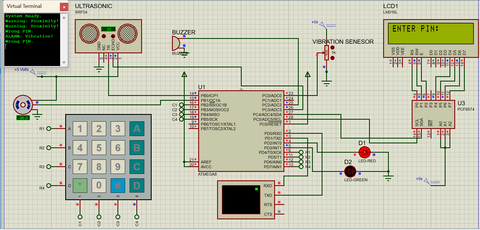
The full system was schematic-captured in Proteus and simulated end to end —
keypad entry, the ENTER PIN → ACCESS GRANTED flow, proximity warnings, and the
vibration alarm — so the firmware and wiring were verified on virtual hardware before
committing to physical parts.
Proteus capture & simulation — ATmega8 driving the keypad, LCD, ultrasonic and vibration sensors, RFID, buzzer, and status LEDs, validated before any wiring.
Bench Build
Bench assembly and testing.
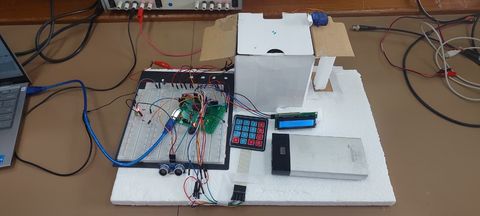
The design didn’t stop at simulation. It was wired up on a breadboard and run on real
hardware — keypad, LCD, ultrasonic and vibration sensors, and a servo actuating a physical
enclosure — closing the loop from a Proteus schematic to a working prototype.
The breadboard prototype on the bench — ATmega8, keypad, LCD, ultrasonic sensor, and a servo-actuated enclosure, matching the simulated design.