Couple a 2.4 hp engine at 3800 rpm to a 1.6 hp compressor at 1500 rpm.
The compressor sets the load, so the gearbox is a 2.53:1 reduction (3800 → 1500 rpm).
The project sizes the full drivetrain — two shafts, a spur-gear set, the
bearings, and the compressor head bolts — as one coherent machine rather than
four disconnected homework problems, and every component targets a design factor of
safety of 2.5 for infinite life.
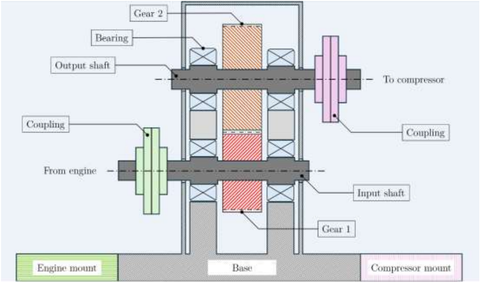
System layout — engine → input shaft & pinion → output gear & shaft → compressor, on ball bearings in a mounted housing.
The Load
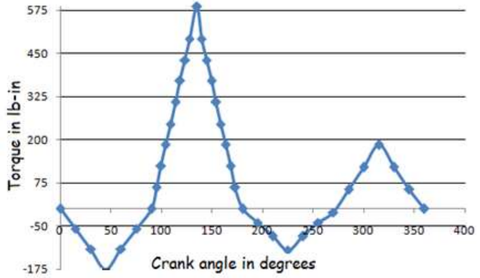
Compressor torque varies throughout each crank cycle.
The torque cycle (max 585, min −175 lb-in) gives a mean of 205 and an
alternating component of 380 lb-in. That alternating load — not the peak — is what
governs fatigue, so the shafts are sized against fully reversed bending plus
fluctuating torsion, not a single static worst case.
Compressor torque over one cycle — the alternating load that drives the fatigue design (Tmax 585, Tmin −175 lb-in).
Shafts
DE-Goodman fatigue sizing in SAE 1020 cold-drawn steel.
Each shaft is modelled as a simply supported beam with the gear load at mid-span, then
sized with the DE-Goodman criterion using Marin-corrected endurance limits
(surface, size, and 99.9% reliability factors). A second iteration adds the real
shoulder-fillet stress-concentration factors and shaft self-weight.
Shaft
Diameter
Method
Resulting FOS
Input (engine side)
1.125 in
DE-Goodman
≈ 4.6
Output (compressor side)
1.1875 in
DE-Goodman
≈ 4.4
Gears
AGMA bending and contact checks on a 32 : 81 spur set.
A Pd 8, 20° spur set (32-tooth pinion, 81-tooth gear, 1.25 in face) in AISI 4140
nitrided steel (230 HB) gives the 2.53 ratio while clearing interference. Both members
are checked for AGMA bending and contact (pitting) strength at a ~3980 ft/min
pitch-line velocity, Quality Index 10.
Member
Teeth
Bending SF
Contact SF
Pinion
32
≈ 5.4
≈ 2.1
Gear
81
≈ 6.7
≈ 3.3
Bearings & Fasteners
Standardized bearings and a fatigue-safe head-bolt joint.
Bearings — single-row deep-groove 02-35 ball bearings on both shafts (sized
for a 20,000-hour life with an application factor); standardizing on one bearing
simplifies spares and assembly.
Head bolts — six 1/4"-20 UNC Grade 5 screws clamp the compressor head with a
confined gasket to keep joint stiffness high; a 75%-proof preload (~2027 lb) gives
a fatigue factor of ≈ 1.68 and a separation factor of ≈ 20 against the 0–1000 lb
pressure load.
Design Automation
A parametric Python tool, so resizing a shaft is one input change.
To avoid re-deriving fatigue by hand on every iteration, I wrote a small Python
(xlsxwriter) generator that builds a live DE-Goodman shaft calculator: enter the
material strengths, torque and moment ranges, stress-concentration factors and a trial
diameter, and the sheet returns the size factor, the Marin-corrected endurance limit, the
Von Mises alternating and mean stresses, the resulting Goodman safety factor, and
the minimum required diameter. The input (engine) and output (compressor) shafts sit side
by side with shared material properties, so a change in load or material is a one-cell
edit instead of a page of re-derivation.
Outcome
Integrated drivetrain sizing and reported safety factors.
The design specifies shaft and bearing sizes, a 32:81 spur-gear pair, and compressor
head bolts. The reported shaft fatigue factors exceed the 2.5 target; the pinion
contact safety factor (≈2.1) and bolt fatigue factor (≈1.68) are below it. The assembly
was modelled in SOLIDWORKS and Fusion 360 to check geometry and fit.