A sumo robot has one job: detect the other robot and push it out of the ring without
driving itself out. That makes it a tight little mechatronics problem — a low, sturdy
chassis, enough traction to push, and sensors to know where the opponent is. This is
the design and build of that robot.
The Design
A ~200 mm box chassis, modelled panel by panel.
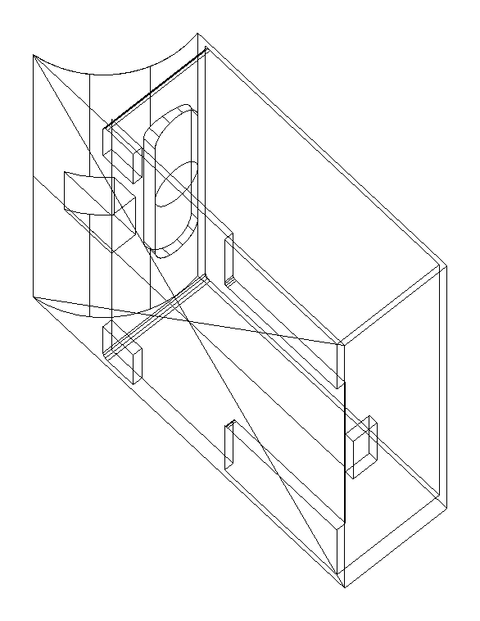
The robot was modelled in Fusion 360 and detailed as flat panels in AutoCAD — a
ground plate, roof, and four walls that assemble into a ~200 × 200 mm box (the
mini-sumo size class) with ~60 mm sides. The front face carries a rounded sensor
aperture so the infrared sensors can see straight ahead, and the base is cut to seat the
drive and walls. Drawing each panel to dimension means the body could be cut and assembled
to a consistent spec.
Assembled CAD model (Fusion 360 / AutoCAD) — the box chassis with its curved leading face and the oval sensor aperture for the forward IR sensors.
Sensing
Infrared eyes on the opponent.
Forward-facing infrared proximity sensors let the robot detect an opponent in front of
it and drive toward it — a simple closed-loop behaviour (sense → steer → push) rather
than blind, pre-programmed motion. It’s the same sensor-feedback thinking that runs through
the rest of my work, shrunk down to a 20 cm box.
The Build
Chassis assembly and bench build.
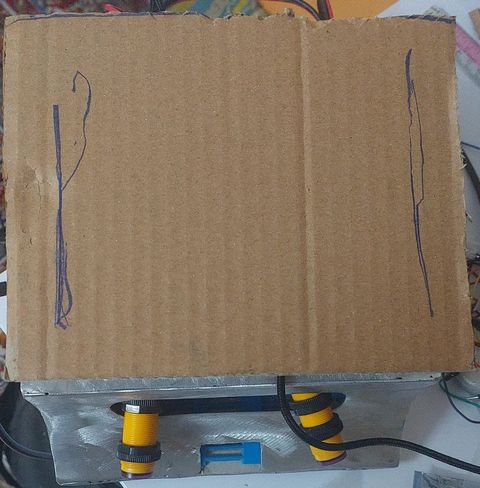
The design was built into real hardware: an aluminium base plate, the forward IR
sensors, a low wheeled drive, and the panel body — shown here mid-build with a temporary
cover. Rough edges and all, it’s a working robot rather than a render: the point of a
sumo bot is that it has to survive contact and keep pushing.
The built robot — an aluminium base with the forward IR proximity sensors and drive, under a low box body (the top here is a temporary working cover).